

Cabo San Lucas Driving Tips: Essential Baja Road Rules Guide
Planning a trip to the tip of the Baja California peninsula offers breathtaking scenery, from desert mountains to pristine coastal shorelines SJD Airport to Cabo San Lucas transfer.
Whether you plan to drive from Los Cabos International Airport (SJD) to your resort, commute along the Tourist Corridor, or take day trips to Todos Santos and La Paz, local road conditions require your full attention Private transportation along the Tourist Corridor.
Understanding the Road Network in Los Cabos
The main artery connecting the entire destination is Highway 1, also known as the Carretera Transpeninsular Cabo San Lucas airport transfer options.
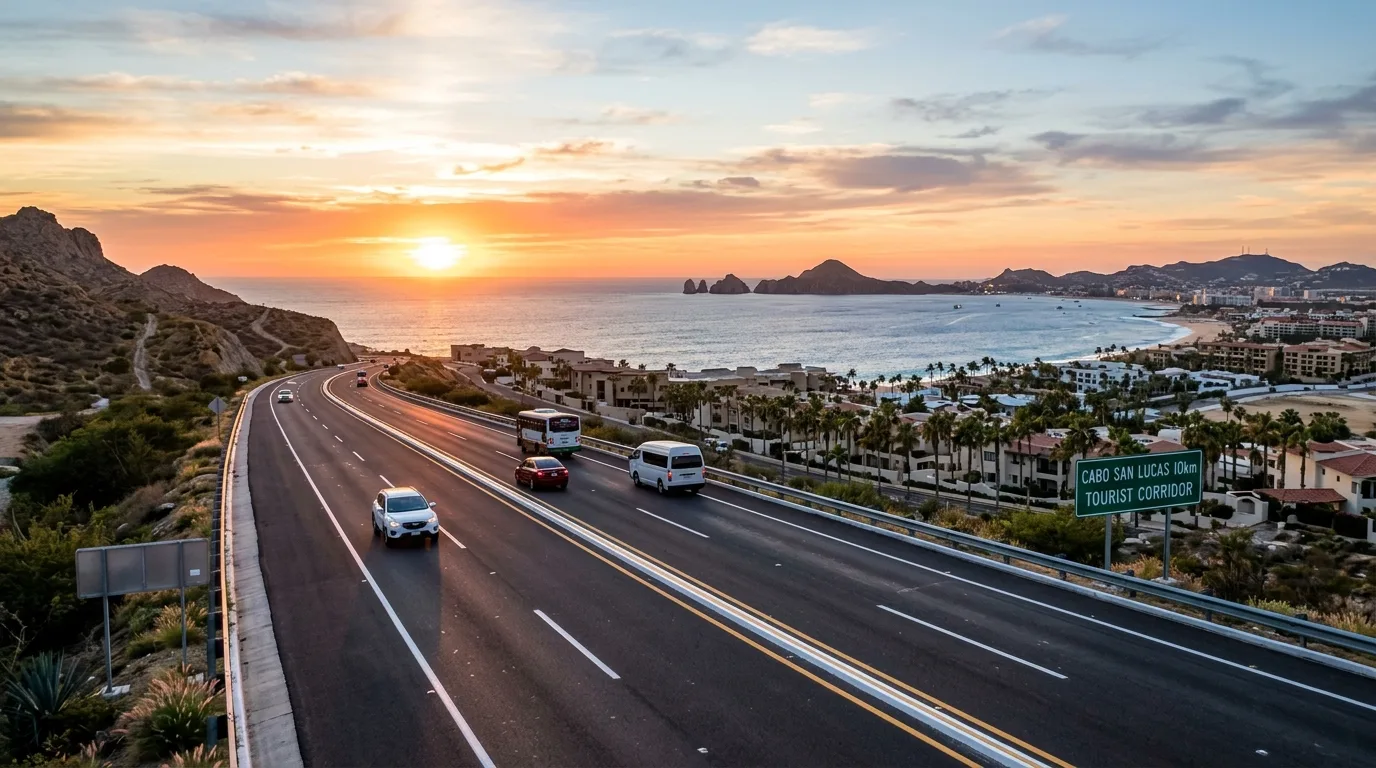
Between San José del Cabo and Cabo San Lucas lies the 20-mile stretch known as the Tourist Corridor Airport transfers Cabo San Lucas guide.
In addition to Highway 1, visitors traveling from the airport can use Highway 1D, locally known as the Libramiento SJD airport to resort transfer guide.
Essential Mexican Traffic Laws and Driving Culture
Navigating highways and city streets in Los Cabos requires adjusting to local driving habits and statutory rules Family transportation in Cabo San Lucas.
- Speed Limits in Kilometers per Hour: All posted speed signs display limits in kilometers per hour (km/h), not miles per hour. Standard limits are generally 40 to 60 km/h in urban areas and 80 to 90 km/h on open sections of Highway 1. Keep a close eye on speedometer conversions to avoid accidental speeding.
- The Infamous Topes (Speed Bumps): Asphalt and concrete speed bumps, known locally as topes, are deployed heavily across Mexican roads to enforce speed limits. They range from small yellow domes (boyas) to massive asphalt mounds. Often, they appear abruptly near pedestrian crossings, school zones, and city entrances without advance warning signs. Hitting a tope at regular speeds can severely damage a vehicle’s suspension or tires.
- Yielding in Roundabouts (Glorietas): Roundabouts are widely used throughout Los Cabos, especially along urban corridors and hotel entrances. Vehicles inside the roundabout always have the right of way. Traffic entering the roundabout must yield until a safe gap appears.
- Left Turns and Lateral Lanes (Lateral System): In larger urban stretches, turning left off a main road often requires using an outer lateral lane (carril lateral) or a designated turn-around point called a retorno. Drivers cannot simply flip a left blinker from the center lane; you must enter the designated loop or right-hand bypass to make a U-turn or broad left.
- Turn Signal Etiquette: On single-lane highways outside the city, a heavy truck using its left turn signal often indicates to the driver behind that the road ahead is clear to pass. However, never rely solely on this signal without verifying clear visibility for yourself.
Toll Roads and Payment Methods in Los Cabos
When driving from SJD airport to Cabo San Lucas, taking the Libramiento toll road (Highway 1D) saves roughly 15 to 20 minutes of stop-and-go city transit. Knowing how tolls operate ensures a fast toll booth transaction.
Toll booths in Baja California Sur generally accept cash in Mexican Pesos ($MXN) and U.S official Los Cabos tourism information.
Toll rates are charged per axle and vehicle class. Standard passenger cars, crossovers, and SUVs pay a flat rate at each toll gantry. Ensure you store your toll receipt until you reach your final destination, as it occasionally serves as proof of insurance coverage for highway infrastructure issues.
Navigating Police Checkpoints and Traffic Stops
Seeing armed military or federal police officers on public roads can startle first-time visitors. However, security checkpoints are standard safety measures across Baja California Sur, aimed at preventing illegal activity and maintaining regional security.
When approaching a military or local police checkpoint, slow down completely, turn off high beams if driving at night, dim your interior lights, and wait for instructions. Officers may ask where you are coming from and where you are headed. Always maintain a polite, respectful demeanor. In most instances, officers will simply wave tourists through after a brief glance into the passenger cabin.
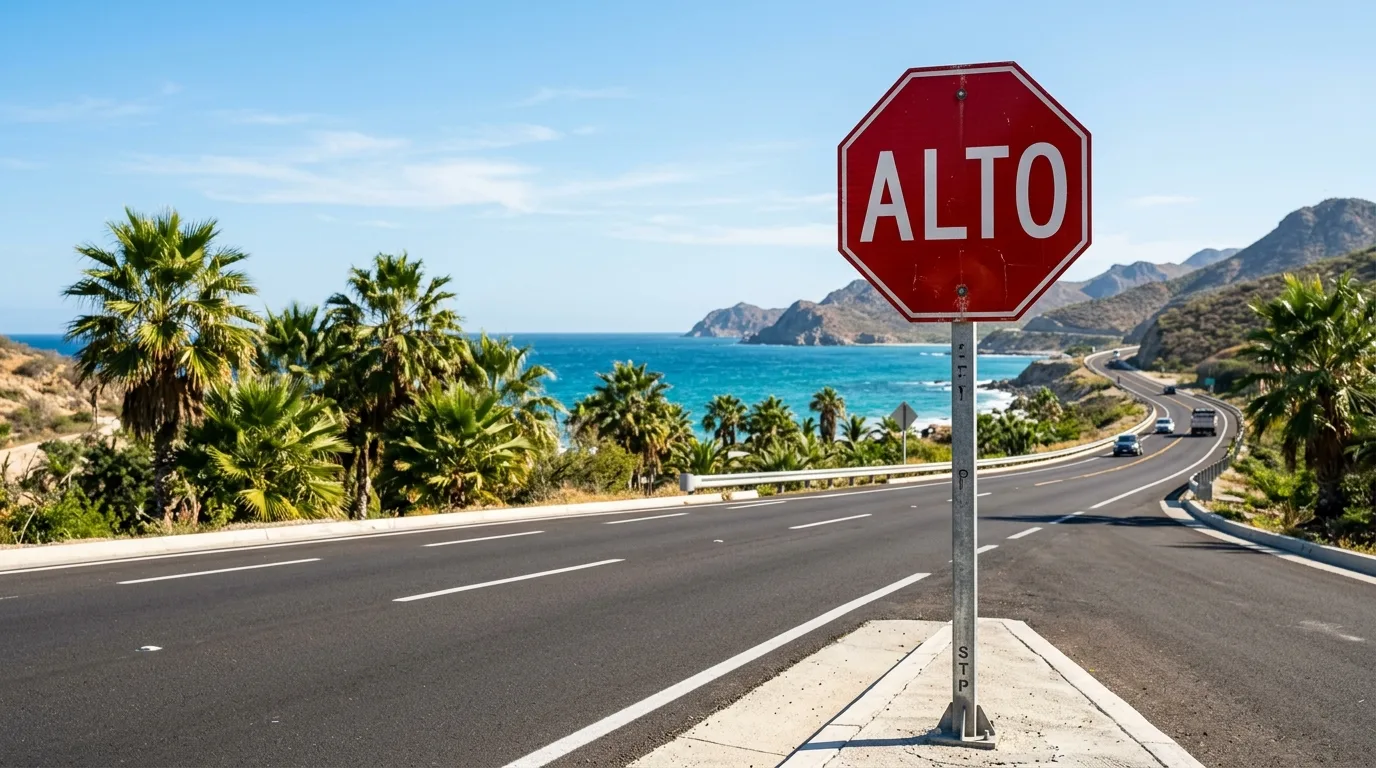
If you are pulled over by traffic police (Tránsito) for a routine moving violation like speeding or rolling through a stop sign (ALTO), remain calm and follow official protocol:
- Request an official paper citation (boleta de infracción).
- Avoid offering cash or paying on-the-spot fines to individual officers, as this is illegal under Mexican law.
- Under municipal procedures, officers may retain your driver’s license or rental vehicle registration until the fine is settled at the local police station (comandancia de policía).
- Many municipal police stations offer a 50% discount on minor traffic fines if paid within 24 to 48 hours of issuance.
Gas Stations and Fueling Etiquette in Baja
Refueling your vehicle in Mexico operates differently than self-service pumps found in North America. All fuel stations across Los Cabos are full-service operations where an attendant dispenses the fuel for you.
Major brands operating in the region include Pemex, Mobil, BP, Chevron, and OXXO Gas. When pulling up to the pump, follow these steps for a secure fueling experience:
First, specify the fuel type and total amount you want. Magna represents regular unleaded (87 octane), Premium corresponds to high-octane fuel (91 octane), and Diésel is clearly marked. You can ask for a specific peso amount (e.g., “quinientos pesos” for 500 pesos) or ask to fill the tank (“lleno”).
Second, before the attendant pulls the nozzle, look at the pump display and confirm that the meter reads zero (“cero”). This simple check prevents paying for residual fuel from a previous customer.
Finally, pay the attendant directly once fueling is complete. Cash is always preferred to avoid potential credit card skimming or processing issues. If paying with cash, call out the bill denominations as you hand them over (e.g., “here is a 500-peso bill”) to prevent misunderstandings regarding change. A small tip of 10 to 20 Mexican pesos is customary for attendants who clean your windshield, check tire pressure, or provide friendly service.
Parking Rules in Cabo San Lucas and San José del Cabo
Finding a secure parking space in downtown Cabo San Lucas, near the marina, or in historic San José del Cabo requires understanding curb markings and parking options. Parking in an unauthorized area can quickly result in vehicle immobilization (a wheel boot) or towing.
Pay strict attention to painted curb colors along city streets:
| Curb Color | Meaning / Rule |
|---|---|
| Red (Rojo) | No parking at any time. Towing and booting enforced strictly. |
| Yellow (Amarillo) | Restricted zone (loading area, taxi stand, or emergency access). Do not park. |
| Blue (Azul) | Reserved exclusively for drivers with valid disability permits. |
| White or Unpainted | General public parking permitted, unless blocked by driveway access. |
In addition to street parking, paid public parking lots (estacionamientos públicos) are plentiful near the Cabo San Lucas Marina, Puerto Paraíso Mall, and Medano Beach Los Cabos municipal tourism information.
When visiting luxury resorts or fine dining establishments, valet parking is widely available. Valet service is often complimentary for resort guests or restaurant diners, though giving a cash tip of 50 to 100 pesos to the attendant upon vehicle retrieval is expected.
Night Driving and Rural Road Hazards
One of the most important driving safety guidelines for Baja California Sur is to avoid driving long distances outside major urban zones after dark. While main resort corridors feature overhead lighting, rural stretches of Highway 1 and secondary coastal roads lack illumination.
Key hazards associated with nighttime driving in Baja include:
- Free-Roaming Livestock: Ranching remains common across Baja. Cattle, horses, donkeys, and goats frequently wander onto unlit highways at night seeking warmth from the asphalt. Hitting large livestock at high speeds presents severe danger.
- Narrow Shoulders and Drop-Offs: Outside urban centers, roads often lack paved emergency shoulders. Steep drop-offs directly alongside the driving lane leave zero margin for error if you drift off course.
- Unlit Vehicles: Local work trucks, agricultural equipment, or bicycles frequently travel without functional tail lights or reflectors.
- Extreme Weather and Flash Flooding: During the late summer and early autumn hurricane season, sudden tropical rainstorms can create powerful storm runoffs across road dips (vados). Never attempt to drive through flowing water over a roadway dip.
Car Rental Considerations and Mandatory Insurance
Renting a vehicle in Los Cabos involves unique contractual and insurance requirements that surprise many international tourists. The most common pitfall involves third-party liability coverage.
Under Mexican federal law, every driver operating a vehicle in the country must carry valid Mexican Third-Party Liability (TPL) insurance issued by an authorized Mexican insurance carrier. United States or Canadian personal auto policies do not cover liability in Mexico. Furthermore, while credit card companies may offer Collision Damage Waiver (CDW) protection for damage to the rental car itself, they rarely provide Mexican third-party bodily injury and property damage liability coverage.
When reserving a rental car online, advertised daily rates often appear ridiculously low (such as $5 to $10 USD per day). However, upon reaching the rental counter at SJD airport, travelers discover that mandatory Mexican liability coverage is added on, significantly increasing the final price. To avoid rental counter surprises, ensure your reservation quote explicitly includes mandatory Mexican Third-Party Liability insurance.
Before driving off the rental lot, conduct a thorough inspection of the vehicle. Take detailed photos and videos of all four sides, wheels, windshield glass, and interior condition. Ensure all existing dents, scratches, and windshield chips are clearly documented on the rental agency’s check-out sheet to prevent unfair damage charges upon return.
Renting a Car vs. Private Transportation: Which Is Right for You?
Deciding whether to rent a car or hire professional private transportation depends heavily on your vacation style, planned itinerary, and overall comfort level with navigating unfamiliar international roads.
Renting a car makes sense for travelers planning extensive multi-day road trips across the state—such as driving north to Todos Santos, surfing remote East Cape breaks, or exploring La Paz beaches. It offers maximum daily independence for frequent regional explorers.
However, for travelers focused on relaxation, resort amenities, dining out, and beach outings within the main Los Cabos corridor, driving a rental car often introduces unnecessary stress. Navigating complex retornos, dealing with parking hassles in downtown Cabo, managing rental insurance disputes, and abstaining from alcoholic beverages during dinners can detract from a relaxing getaway.
| Factor | Renting a Vehicle | Private Airport Transportation |
|---|---|---|
| Navigation & Stress | High. Requires constant map tracking and watching for local road hazards. | Zero. Professional bilingual drivers handle all traffic and navigation. |
| Upfront Cost Transparency | Variable. Advertised rates exclude mandatory Mexican liability insurance. | 100% Transparent. All-inclusive flat rates with no hidden fees or deposits. |
| Parking & Fueling | Self-managed. Requires finding paid lots and handling cash fuel transactions. | Eliminated. Door-to-door drop-off right at your hotel lobby or villa entrance. |
| Group & Family Convenience | Limited space for luggage in standard rental vehicles; multiple cars needed for groups. | Spacious luxury SUVs and vans accommodating large families and all luggage easily. |
| Night Travel Safety | Requires caution due to unlit roads, topes, and unfamiliar traffic patterns. | Safe and restful. Chauffeurs are expert local drivers trained in highway safety. |
Choosing private transportation allows you to step off your flight at SJD Airport and immediately transition into vacation mode without standing in rental car counter lines, blocking heavy security credit card holds, or worrying about Baja road rules.
Frequently Asked Questions
Do I need an International Driving Permit to drive in Cabo San Lucas?
No, an International Driving Permit (IDP) is not required for visitors holding a valid driver’s license from the United States, Canada, the United Kingdom, or Europe official Los Cabos municipal information.
What should I do if I hit a speed bump (tope) too fast?
If you hit a tope at speed, pull over safely as soon as possible to inspect your vehicle. Check for tire bulges, air pressure loss, rim damage, fluid leaks under the engine, or alignment pulling. If you suspect mechanical damage on a rental vehicle, contact your rental agency’s roadside assistance immediately before continuing your trip.
Is driving from SJD Airport to Cabo San Lucas safe for tourists?
Yes, driving from SJD Airport to Cabo San Lucas is generally safe, especially during daylight hours. Taking the Highway 1D toll road (Libramiento) provides a well-maintained, modern bypass with clear signage. However, drivers must remain alert for speed limits, fast commuters, and abrupt exits.
Are U.S. auto insurance policies valid in Los Cabos?
No, U.S. and Canadian personal auto insurance policies are not legally valid in Mexico. Mexican law mandates that all drivers carry civil liability insurance issued by an authorized Mexican insurer to cover potential injury or property damage to third parties.
How much cash should I keep in the vehicle for tolls and gas?
It is best to keep approximately 500 to 1,000 Mexican pesos in cash stored securely in your wallet or vehicle for tolls and gas station payments. Having smaller bills (50 and 100 peso notes) makes paying at toll booths and tipping gas station attendants quick and painless.
What does the road sign ‘ALTO’ mean?
The sign ‘ALTO’ is the Mexican traffic equivalent of an octagonal STOP sign. You must bring your vehicle to a complete stop behind the stop line or crosswalk before proceeding. Rolling stops are frequently ticketed by municipal police officers in tourist zones.
Can I turn right on red in Cabo San Lucas?
Turning right on red is generally permitted at intersections in Baja California Sur after coming to a full stop and yielding to oncoming traffic and pedestrians, unless a sign specifically prohibits it (e.g., ‘NO VUELTA CON LUZ ROJA’). Always exercise extreme caution before turning.
What should I do if a traffic police officer pulls me over?
Remain calm, pull over safely, and stay inside your vehicle. Turn on interior lights if it is dark. Present your driver’s license and rental paperwork when requested. If cited for a minor violation, ask for an official paper ticket to pay at the station rather than paying cash directly to the officer.
Why are left turn lanes on Highway 1 arranged differently?
Highway 1 uses dedicated turning loops called retornos or right-hand lateral bypasses to manage heavy traffic safely. Instead of making a direct left turn across multiple oncoming lanes, drivers exit to the right or enter a designated U-turn lane to reverse direction safely before making their turn.
Is it safe to drive in Cabo San Lucas at night?
While urban resort areas like the main Tourist Corridor and downtown Cabo are reasonably well-lit, driving on rural highways outside city limits at night is not recommended. Unlit roads, free-roaming livestock, narrow shoulders, and unlit vehicles create significant hazards for drivers unfamiliar with the terrain.
Conclusion: Driving Safely in Cabo San Lucas
Exploring Los Cabos behind the wheel can offer freedom for adventurous visitors who are comfortable adapting to international traffic customs, speed bumps, unique turning maneuvers, and local insurance rules. By following these essential Cabo San Lucas driving tips, keeping speed limits in check, and staying alert for local road conditions, you can enjoy a secure and memorable trip across Baja California Sur.
However, if your ideal vacation centers on total relaxation without the hassle of navigating local highways, finding parking, or managing rental contracts, private airport transfers offer complete peace of mind. Choya Transportation provides professional, pre-booked private transfers directly from SJD Airport to your resort or vacation rental, ensuring your journey across Los Cabos is smooth, comfortable, and completely stress-free.